
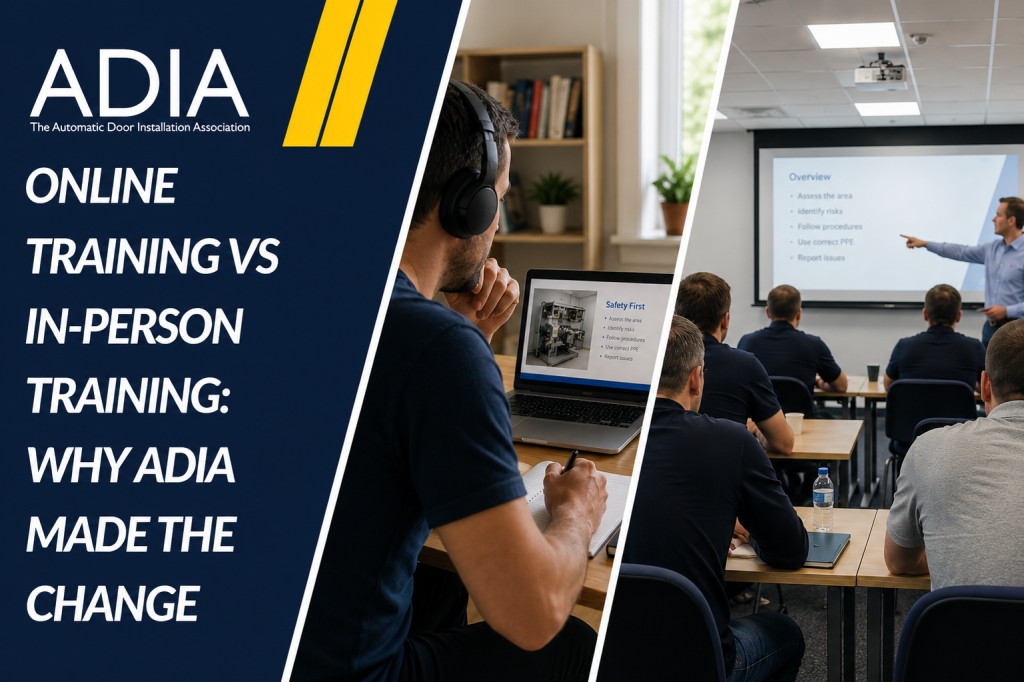
Before the COVID-19 lockdowns (where has the time gone?!), ADIA training looked very different.
Our trainer would travel across the country, often delivering courses to small groups of engineers at various venues. Sometimes we would need to bring in external trainers to support delivery, which naturally added additional costs. There were venue hire fees, fuel costs, overnight accommodation, travel expenses and the time required to organise and manage every course.
As many engineers will know, the automatic door industry does not always run to plan.
Emergency call-outs happen. Urgent customer requests arise. Engineers can find themselves travelling across the country at short notice. Unfortunately, this sometimes meant engineers were unable to attend training that had already been booked. The result was cancellation fees, wasted venue costs and valuable time lost for both the engineer and the association.
For a small organisation, these challenges can have a significant impact.
Why ADIA Operates as a Small Team
Since ADIA was founded in 2013, we have intentionally remained a small team.
This allows us to keep our costs under control, provide a personal service and reinvest membership subscriptions into the areas that matter most: training, member benefits, technical support and industry initiatives.
In fact, our membership pricing has remained unchanged since our inception. If installer membership had increased in line with inflation, it would now cost £144.23 per month including VAT rather than the current £99.99.
We believe our members receive better value when resources are invested into services rather than administration.
The Impact of COVID-19
When the COVID-19 lockdowns began, like many organisations, we had to adapt quickly.
As key workers, engineers still needed access to training and qualifications in order to continue working safely and compliantly. Closing training altogether was not an option.
The solution was to move our training online (which we had done, in part, before).
Initially, this was a necessity. However, what we discovered was that online learning offered a range of benefits that many engineers preferred over traditional classroom-based training.
The Advantages of Online Training
When people hear “online training”, they often imagine a simple PowerPoint presentation.
Our courses are much more than that.
The training includes voiceovers, visual demonstrations, interactive elements and mock examinations designed to prepare engineers for their assessments.
Unlike a classroom environment, online learning allows engineers to learn at a pace that suits them.
Need to pause a section and answer a phone call? No problem.
Want to replay a module to make sure you’ve understood a technical requirement? You can.
Prefer to complete your training over several evenings rather than a full day away from work? That’s entirely possible.
Every engineer learns differently, and online training gives them the flexibility to learn in a way that works best for them.
Less Time Travelling, More Time Learning
One of the biggest benefits is convenience.
There is no need to travel across the country, book hotels, arrange cover for work or lose productive hours sitting in traffic.
Engineers can complete their training from home, the office or wherever suits them best.
For employers, this means less disruption to schedules and fewer lost working hours.
For engineers, it means less stress and greater flexibility.
Building Confidence Before Assessment
Not everyone enjoys sitting in a classroom or taking exams in front of other people.
Online training allows engineers to work through mock examinations and learning materials at their own pace before taking their final assessment.
Many engineers tell us this helps them feel more confident and better prepared.
Rather than being rushed through a course because the rest of the class is ready to move on, they can take the time they need to fully understand the content.
Designed for Engineers at Every Stage of Their Career
One of the challenges of classroom-based training is that every engineer arrives with a different level of experience.
Some may be new to the industry and looking to build a solid foundation of knowledge. Others may have been working with automatic doors, gates or access control systems for many years and simply need to refresh their knowledge, update their understanding of standards or maintain compliance.
Online training allows us to cater to both.
Our courses are carefully designed to support engineers at different stages of their careers, enabling each individual to focus on the areas where they need the most development whilst progressing through the course at a pace that suits them.
We also deliberately reinforce key concepts throughout our courses. Important information is repeated at appropriate points to improve knowledge retention and ensure critical requirements are not overlooked. This approach helps engineers absorb and retain information more effectively than a single mention during a classroom presentation.
It is also important to recognise that the engineers undertaking our courses are professionals. Most already possess a level of industry knowledge and practical experience. Many do not require every aspect of a subject to be explained in minute detail or delivered at the pace of the least experienced person in the room.
Online learning allows experienced engineers to progress efficiently through familiar topics whilst still ensuring they fully understand the key principles, standards and safety requirements covered by the course.
The result is training that is flexible enough to support newcomers, valuable enough to benefit experienced engineers and structured enough to ensure that nobody misses the information that matters.
Support Is Still Available
A common misconception is that online training means learning alone.
At ADIA, that has never been our approach.
If an engineer has a question, we are available by telephone, email and even text message. Whether it’s a technical query, help with a course or guidance on an assessment, support is only a phone call away.
Online delivery has changed the way training is accessed, but it has not changed the level of support we provide.
Looking Forward
Classroom training will always have its place in certain situations. However, for many engineers and employers, online learning offers a more flexible, cost-effective and practical solution.
What began as a response to a global pandemic has evolved into a training model that better suits the realities of modern engineering.
The goal remains exactly the same as it was in 2013: providing high-quality training that is accessible, affordable and designed around the needs of the industry.
For ADIA, online training is not simply an alternative to classroom learning.
It is an opportunity to make training more accessible, more flexible and ultimately more effective for the engineers we support every day.