
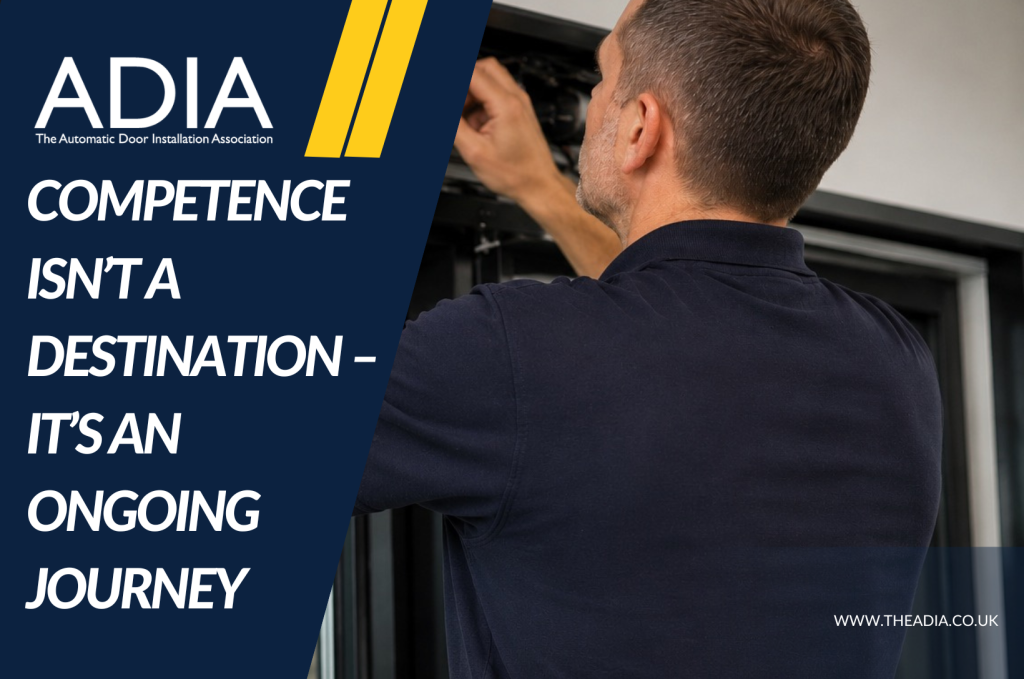
In the automatic door, industrial door, gate, barrier and access control industries, the word competence is used more than ever before.
Clients ask for evidence of competence. Principal contractors ask for proof of competence. Industry bodies, insurers and regulators all talk about competence.
But what does it actually mean?
For many years, competence was often viewed as a qualification or certificate. Once training had been completed, the box was ticked and attention moved elsewhere.
Today, the industry is recognising that competence is much broader than that.
Competence is a combination of training, knowledge, experience and ongoing development. It isn’t something that is achieved once and then forgotten. It is something that must be maintained throughout an engineer’s career.
Standards change. Technology develops. Safety requirements evolve. New products enter the market. What was considered best practice ten years ago may no longer be sufficient today.
That’s why continuing professional development is becoming increasingly important across the industry.
Training remains one of the most effective ways of maintaining competence. Whether it’s BS EN16005, Gate & Barrier Safety, Industrial Door Safety, Access Control or Surveying & Estimating, training helps engineers stay informed, confident and up to date.
However, competence extends beyond the classroom.
Regular servicing, fault finding, installation work, risk assessments, technical discussions and practical problem-solving all contribute to an engineer’s professional development. Every job presents an opportunity to learn something new.
At the ADIA, we believe competence should be accessible, measurable and supported. That’s why we continue to invest in accredited training, refresher programmes and the DoorSafe Register, helping engineers demonstrate their skills and commitment to safety.
The reality is that no engineer knows everything. The most competent professionals are often the ones who continue asking questions, seeking guidance and expanding their knowledge.
As an industry, we should celebrate that mindset.
Because competence isn’t about knowing it all.
It’s about having the willingness to keep learning.
And that’s what ultimately helps create safer installations, safer workplaces and greater confidence for our customers.
What does competence mean to you? We’d love to hear your thoughts in the comments.